
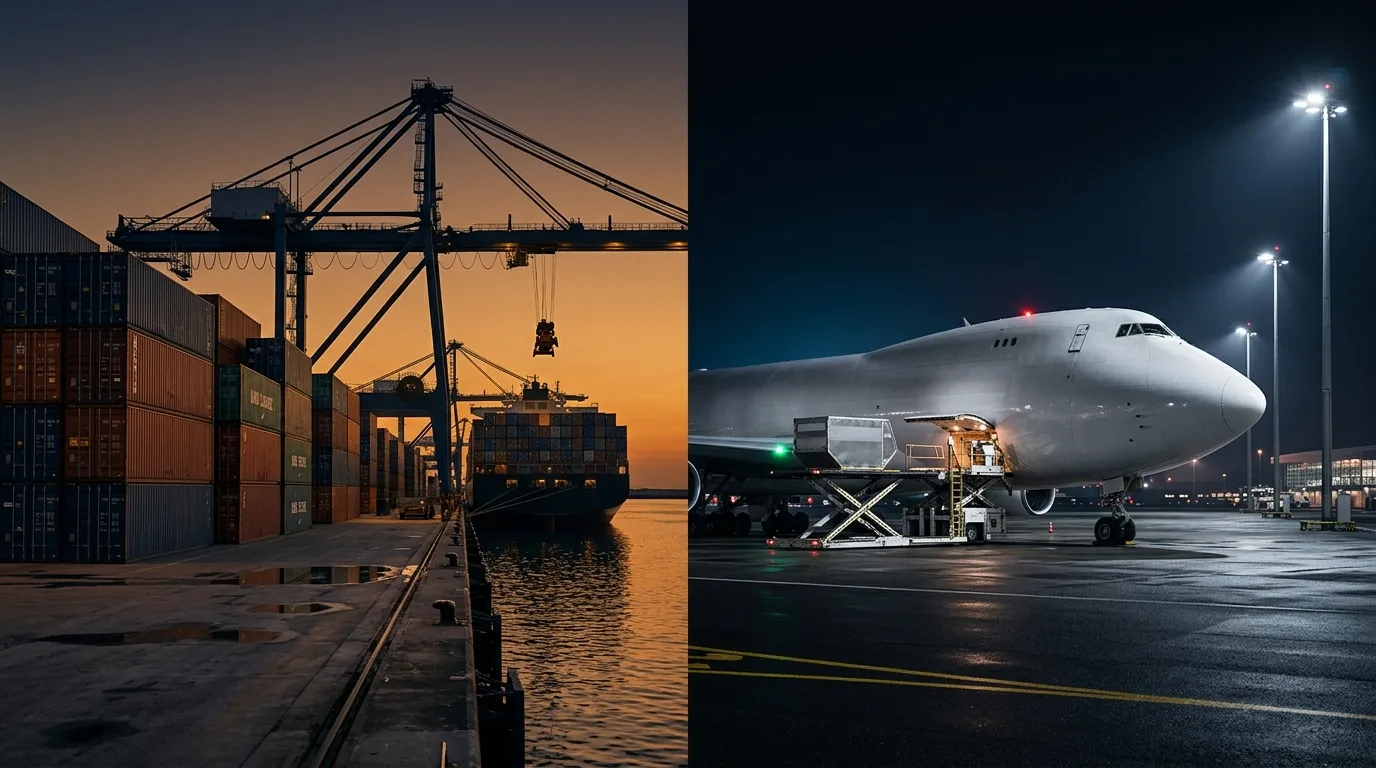
Sea Freight vs. Air Freight: Which Is Right for Your International Move?
When you're planning an international move, one of the first practical questions you face is how to get your belongings from A to B — and the answer almost always comes down to sea freight or air freight. Both methods work, but they serve very different needs. The right choice depends on how much you're shipping, how fast you need it, and how much you're willing to spend.
What's the Difference? Sea Freight and Air Freight Explained
Both sea freight and air freight move your household goods from one country to another — but the similarities largely end there. Sea freight uses large cargo ships that carry standardised steel containers across international shipping lanes. Air freight puts your belongings in the hold of a commercial or cargo aircraft and flies them to their destination in days.
For most international moves, sea freight involves either a Full Container Load (FCL) — where you fill an entire 20ft or 40ft container — or a Less than Container Load (LCL), where your goods share container space with other shipments. Air freight is typically measured by weight and volume, and charges are calculated on whichever is greater (actual weight or dimensional weight).
How Each Method Gets Your Goods There
With sea freight, your moving company packs and loads your belongings at origin, the container is sealed and transported to the departure port, then it sails to the destination port before customs clearance and final delivery to your new home. With air freight, goods are packed to airline specifications, driven to a cargo terminal, loaded into the aircraft hold, flown to the destination airport, cleared through customs, and delivered.

Understanding this process matters because the method you choose affects not just cost and speed, but how your goods are packed, what documentation you need, and how customs handles your shipment at the other end.
Cost Comparison: Sea Freight vs. Air Freight
Cost is usually the deciding factor — and the difference is substantial. Air freight is priced by weight and volume, making it prohibitively expensive for full household moves. Sea freight is priced by cubic metre or container size, which makes it far more economical when you're moving a significant volume of goods.
As a rough guide for moves originating from India, a standard two-bedroom household move by sea freight typically costs ₹3–6 lakh (depending on destination and container share), while the same volume sent by air freight could cost ₹15–40 lakh or more. The table below breaks down how the two methods compare across every factor that matters.
| Factor | 🚢 Sea Freight | ✈️ Air Freight |
|---|---|---|
| Cost (per CBM / kg) |
Low — priced by cubic metre (CBM) ✓ Cost Winner |
High — priced by actual or dimensional weight, whichever is greater |
| Transit Time | 14–45 days depending on route and origin port |
3–7 days door-to-door ✓ Speed Winner |
| Best For | Full household moves, furniture, large volumes | Essential items, documents, high-value electronics |
| Volume Limit | No practical limit — 20ft or 40ft full containers available | Typically limited to 50–200 kg for a moving shipment |
| Customs Risk | Standard — port customs with full inspection possible |
Lower risk of damage; higher scrutiny for restricted items |
| Packing Requirements | Professional packing required; wooden crating for fragiles | Airline-approved packing; strict size and weight limits per piece |
| Insurance | Marine cargo insurance available; required for full coverage | Air cargo insurance available; generally simpler claims |
| Environmental Impact | Lower per-kg carbon footprint for large volumes | Significantly higher carbon emissions per kg shipped |
| Flexibility | Fixed sailing schedules; some LCL consolidation delays |
Daily flights on most major routes; more schedule flexibility ✓ Flexibility Winner |
Transit Times: How Long Will Your Move Take?
Transit time is where air freight has an undeniable advantage — but the full picture is more nuanced than the headline numbers suggest. Your belongings don't just travel on a ship or plane; they also spend time at origin packing, port or cargo terminal processing, customs clearance at both ends, and final-mile delivery. Here are the real-world ranges to plan around.
Planning Around Your Move-In Date
If you're relocating for work and have a firm start date, sea freight requires more lead time — typically you need to plan your packing and collection at least 4–6 weeks before you need your goods at the destination. Air freight affords much more flexibility, but most people find that shipping truly essential items by air and sending the bulk of their household by sea is the most practical and cost-effective approach.
LCL sea shipments (shared container) can add additional transit days because your goods must wait until the container has enough cargo from other customers to depart. FCL (full container) shipments travel on the next available sailing after your container is loaded, giving you more control over timing.
What to Ship by Sea — and What to Send by Air
The most practical answer for most families moving internationally is: ship the bulk by sea, send the essentials by air. Air freight is best used as a precision tool — not a full moving solution. Here's how to split your inventory.
🚢 Ship by Sea
- Furniture, sofas, dining tables, wardrobes
- Kitchen appliances and white goods
- Books, décor, art, and sentimental items
- Clothing beyond your immediate needs
- Sports equipment and bicycles
- Garden tools and outdoor furniture
- Non-urgent household goods of any kind
✈️ Send by Air
- Laptops, tablets, work equipment
- Passports, original documents, certificates
- Medications (check destination country rules)
- Jewellery and high-value small items
- Essential clothing for first 2–4 weeks
- Children's comfort items and school supplies
- Anything you'll need before sea freight arrives
Pack a "sea freight wait kit" — a set of bags or boxes containing everything you need for the first 3–6 weeks abroad. Send this by air. Label your sea freight boxes clearly by room and priority so delivery at the destination is faster and less stressful.
Perishable foods, flammable liquids, aerosols, lithium batteries (in large quantities), and items with sentimental or irreplaceable value that could be damaged in transit. Sea containers can experience significant temperature and humidity variation — plan your packing accordingly.
Customs, Risk, and Insurance: What You Need to Know
Both sea and air shipments pass through customs at the destination country — but the process, documentation requirements, and inspection likelihood differ. Understanding these differences before you ship can save you significant time, money, and stress at the other end. Here are the questions we hear most often.
Sea freight containers are subject to random physical inspection at destination ports — customs authorities can open your container and check the contents against your packing list. The frequency of inspection varies by country and port, but it does happen. Air freight is screened electronically on arrival and may face more scrutiny for restricted items due to airline security protocols, but physical unpacking is less common for personal household shipments.
The core documentation is similar — a detailed packing list, proof of ownership or purchase receipts for high-value items, passport copies, and a customs declaration form — but the shipping document differs. Sea freight uses a Bill of Lading (B/L), while air freight uses an Air Waybill (AWB). Your moving company will prepare these on your behalf. Some destination countries also require a work visa, residency permit, or employment contract to qualify for duty-free importation of used household goods.
For sea freight, marine cargo insurance is strongly recommended and covers loss or damage during ocean transit. For air freight, air cargo insurance provides equivalent protection. Both are typically available through your moving company and priced as a percentage of your shipment's declared value — usually 1–3%. Standard carrier liability is very limited (often just a few dollars per kg), so third-party all-risk insurance is worth the cost for any shipment containing items of significant value.
Yes — and this is actually the approach most international movers take. A split shipment strategy lets you send essential items by air freight so you have what you need immediately upon arrival, while the bulk of your household goods travel by sea at a fraction of the cost. Your moving company handles both shipments under a single move plan, with coordinated customs documentation for both. This is particularly common for moves from India to the UAE, Singapore, and the UK.
How iMove Global Helps You Choose the Right Freight Method
There is no single right answer to the sea vs. air question — it depends on your timeline, your volume, your budget, and your destination. What we've found in over a decade of handling international moving from India, UAE, and Singapore is that most clients benefit from a structured conversation before any decision is made.
Our team maps out your full inventory, your move-in date, and your destination country's customs requirements before recommending a freight split. In many cases we recommend a combination: a small air freight consignment for essentials, and an LCL or FCL sea freight shipment for the household move itself. This keeps costs in check while ensuring you're not sleeping on the floor for six weeks waiting for your bed to arrive.
What the iMove Process Looks Like
Once you confirm your move, our team conducts an in-home survey (in Bangalore, Mumbai, Hyderabad, and other key cities) or a video survey to assess your volume. We provide a detailed quote broken down by sea freight, air freight, packing, and destination customs handling — so you can see exactly what each option costs before committing. You can read more about what to expect in our guide to the international moving process.
Planning an international move and not sure which freight method is right for you? Get a detailed, no-obligation quote from iMove Global — we'll map out the best sea and air freight options for your specific move.
View Our Moving ServicesWhich Should You Choose?
For the vast majority of international moves — especially those originating from India — sea freight is the right choice for the bulk of your household goods. It is significantly more affordable, handles large volumes without penalty, and is well-suited to furniture, appliances, and anything you don't need in the first few weeks abroad. Air freight earns its place as a targeted, high-priority tool: use it for documents, essential electronics, medications, and the clothing and comfort items you'll need while your sea shipment is in transit.
The combination approach — a small air consignment plus an LCL or FCL sea shipment — is the strategy most experienced international movers recommend, and the one iMove Global's team will typically map out for you during your initial consultation. If you're still weighing up timelines, our international moving timeline guide breaks down route-by-route transit windows in detail. And if you're concerned about what a move really costs end-to-end, our guide to hidden moving costs is worth reading before you get your first quote.
Key Takeaways
- Sea freight is far more cost-effective for full household moves — typically 5–10× cheaper than air freight for the same volume.
- Air freight delivers in 5–10 days; sea freight takes 14–45 days depending on origin and destination.
- Use air freight for essentials, documents, and high-value items. Send furniture, appliances, and bulk household goods by sea.
- A split shipment strategy — air for essentials, sea for the rest — is the most practical and cost-effective approach for most moves.
- Both methods require customs documentation — sea freight uses a Bill of Lading, air freight uses an Air Waybill. Your moving company handles both.
- Always take out cargo insurance — standard carrier liability covers very little. Marine or air cargo insurance is typically 1–3% of declared value.
Ready to Plan Your International Move?
Tell us where you're moving from, where you're going, and roughly what you're shipping — and our team will come back with a clear breakdown of sea freight, air freight, and combined-shipment options for your route.